
Most Important: Hair Porosity & Figuring Out Your Own
Understanding hair porosity is a fundamental part of unlocking your hair’s beauty. This creates an easy outline of what products are a yes or no for you. Hair porosity is based on the structure of the cuticle layer, the outermost protective layer of a hair strand. This layer is made up of cuticles that people compare to a roof’s shingles.
Porosity: the ability to absorb & retain moisture; the more/faster water passes in & out, the higher porosity.
╰┈➤ Low Porosity Hair ✧
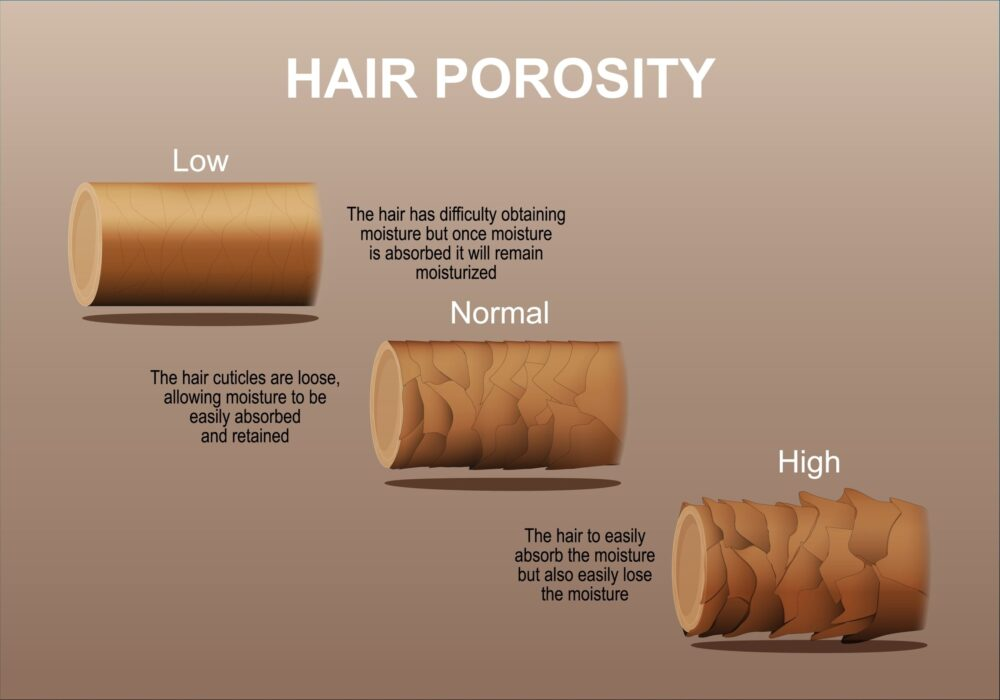
Low-porosity hair is often visually described as looking smooth and shiny, but there’s more to why it’s given that description. The cuticles of the hair are closed and tightly bound together (visuals provided more below). What does it do? Essentially, the hair becomes stubborn to moisture absorption since it cannot pass into and through these cuticles, which act as a barrier (Cincotta, 2026). However, people regard low-porosity hair as the healthiest because it’s best for moisture retention, since moisture penetrates and remains within the hair shaft.
Characteristics
- The hair takes a long while to dry
- When products are put on the hair, it builds up or sit on top of the hair, giving a greasy/sticky look (hair struggles to absorb the product)
- Hair lacks volume, hard to style
Ideal Product Characteristics (Product Recs Coming Soon)
- Light-weight, water-based products (search for products that specify being lightweight for low porosity)
- The product is designed to reduce build-up or oiliness
- Products that clarify the scalp & hair from build-up
- Deep conditioning
╰┈➤ Medium Porosity Hair ✧✧
I like to call this porosity type the “goldilocks” of all hair types. This porosity is more likely to hold different styles and looks visibly shiny and healthy the majority of the time. The cuticles are not too closely knit, but they also aren’t excessively open (“What Type of Hair Porosity Do You Have?,” 2019). The reason this is ideal is because moisture passes through the hair cuticle easier, but is also retained for long periods of time. (visuals provided more below)
Ideal Product Characteristics (Product Recs Coming Soon)
Medium porosity hair doesn’t really require a set specific traits when it comes to products, but these are some helpful characteristics for keeping maintenance…
- Water-based
- Conditioning/moisturizing
- Leave-in products
╰┈➤ High Porosity Hair ✧✧✧
This particular hair porosity is often associated with as a result of hair damage and/or a lack of maintenance, but it could also be due to genetics. The cuticles are widely open or excessively jagged. While the hair may be able to take in moisture easily, it cannot sufficiently retain that moisture (“What Type of Hair Porosity Do You Have?,” 2019). Bleaching and/or heat styling can cause the protective cuticle layer to be stripped and damaged, which results in higher porosity, thirsty hair. (visuals provided more below)
Characteristics
- Hair dries pretty fast
- Visually looks frizzy, damaged, or dry
- Prone to breakage and/or split ends
Ideal Product Characteristics (Product Recs Coming Soon)
- Thicker, moisture-intensive products
- Repairing
- Oils, creams, etc.
- Heat protectants to prevent further damage
- Protein-rich (diet/products)
Want to Figure Out Yours?
As someone who identified her hair porosity incorrectly in the past, I personally think some tests are more reliable than others. :> We all know about the water-in-a-glass float test, where you cut a strand and see if it floats or sinks, but a lot of people seem to get misleading results. This test is a little more reliable:
The Spray Test
On shampooed, product-free hair, spray/mist some water onto your hair; don’t overdo it. If the water beads and takes a significantly long to absorb into your hair, then you likely have low porosity hair. If it doesn’t bead or has trouble absorbing, then you may have medium to high porosity hair.
But, Remember… ♡
At the end of the day, these tests are to help you narrow down what type you may have and assist you in finding what gets your hair feeling amazing. You’ll probably see routines specifically meant for a certain porosity, but remember that we’re all different and you shouldn’t force yourself to do something for your hair simply because it worked out for someone else. Do what gets your hair feeling good. Wash it when you want, do whatever YOU want.
Works Cited:
Cincotta, J. (2026, January 30). Low Porosity Hair Decoded: Expert-Backed Signs, Fixes + Product Musts. Color Wow. https://colorwowhair.com/blogs/all/low-porosity-hair?srsltid=afmbooqbfuilc39tai0t1cckyh8piyqgenjsopnhp-i1g3v3hnc-abwi
What Type of Hair Porosity Do You Have? (2019). In Healthline. https://www.healthline.com/health/hair-porosity#bottom-line